

Dear AAVSO Members, Observers, and Supporters,
The second and third quarters of 2025 were extremely active periods at AAVSO headquarters, characterized by continued execution of the strategic plan, several significant technology transitions, and a full slate of meetings and events. Because the Annual Meeting occurred earlier than usual this year, this report covers developments across both Q3 and Q4 and summarizes the most significant activities and outcomes from the past six months.
Announcements
The AAVSO’s Annual Campaign is currently underway, and we have raised approximately $56,000 to date in support of our core scientific, educational, and community programs. These unrestricted funds are essential to sustaining day-to-day operations and enabling the work described throughout this report. Members and supporters who wish to contribute can do so at aavso.org/donate-now. We encourage those who are able to help us reach our campaign goal of $140,000 and are grateful for your continued support of the AAVSO’s mission.
Strategic Plan Execution and Technology Progress
Over the last two quarters, we continued executing the 2025–2029 Strategic Plan with a strong emphasis on modernizing our technical infrastructure and improving the user experience. As described in a recent blog post by Aru, we rolled out several improvements to the User Profile, Settings, and Search pages, making it easier for members and observers to manage their information and communicate with other people. As part of those improvements, we also revamped the Sites and Equipment applications to make them easier to use and better integrate with the rest of our applications.
For those who observe the Sun, there are several important developments to share. The AAVSO Solar Special Interest Group has observed the Sun since 1944 and was largely self-managed for many years. When headquarters built the SunEntry application in the early 2000s, we strove to retain backwards compatibility with previous reports. As such, it wasn’t fully integrated into AAVSO’s technical infrastructure. As part of our modernization efforts, we have built a new Solar Observing app to replace SunEntry. This new application is presently in beta testing and will be released to the community in January 2026 after which we will work with the Solar SIG to migrate users and retire SunEntry.
Our long-anticipated website transition is nearing completion, and we expect to launch the new site in January or February 2026. As noted in prior Director’s Reports, it is not practical to migrate all 60,000 pages contained on aavso.org to the new website. Instead, we will initially migrate approximately 50 high-value pages. The remaining content will remain accessible at archive.aavso.org and will be migrated incrementally as demand warrants. This approach allows us to move forward while preserving access to AAVSO’s extensive historical content.
Finally, we deployed a new payment processing system. While it is not yet as tightly integrated as our previous online store, it significantly reduces manual effort and backend processing.
Events and Meetings
Stellafane
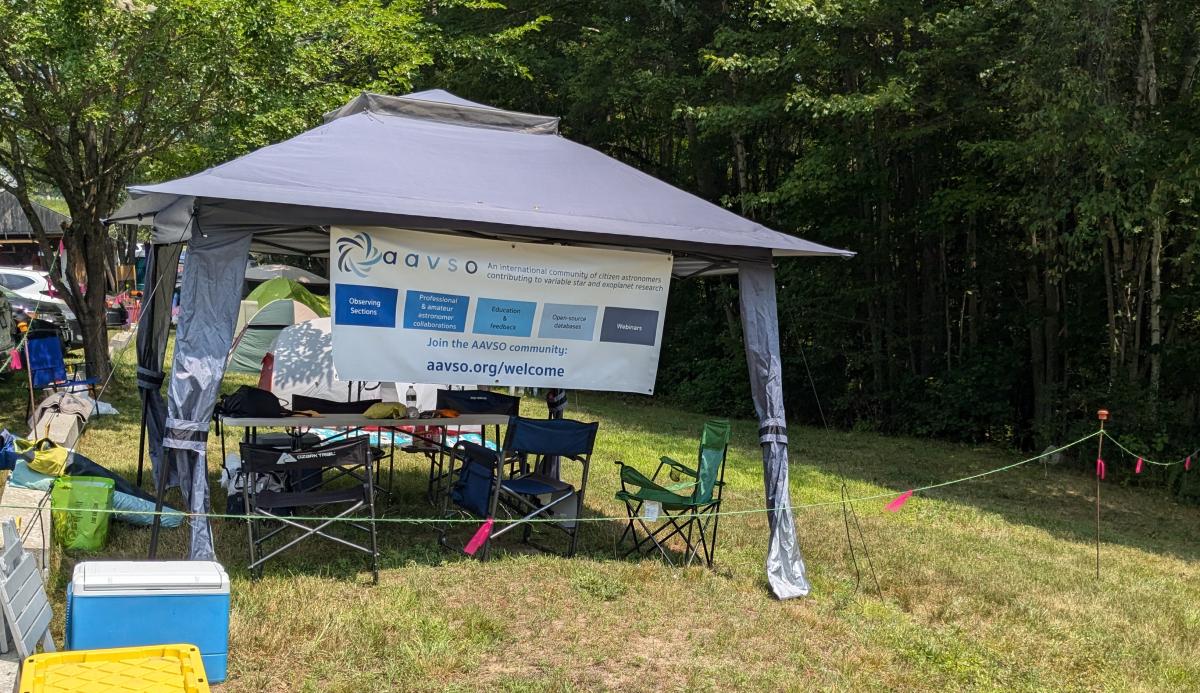
In late July, AAVSO participated in the Hartness House Lecture Series and Stellafane. Kris Larsen, Peter Bealo, Brian Kloppenborg presented talks at both events. Mark Munkacsy and George Silvis volunteered to help staff our “booth” (see the photo below). In total we had around 100 people stop by the booth to learn more about AAVSO’s programs and activities.
AAVSO’s 114th Annual Meeting
In early November we held the 114th Annual Meeting at the Oregon Museum for Science and Industry in Portland, Oregon. The meeting was well attended with 77 participants in person and an additional 51 joining online. The science meeting included two keynote talks, 20 additional presentations, two stakeholder discussions, and a poster session. We also held our annual Member Meeting as part of the program.
The science meeting featured keynote presentations by Dr. Peter Plavchan and Dr. Melissa Gram. Dr. Plavchan discussed NASA’s Landolt CubeSat mission, which will provide a high-precision, space-based photometric reference for professional observatories. Dr. Gram spoke about variable star astronomy in the era of the Vera C. Rubin Observatory, highlighting both the scientific opportunities and the challenges posed by large survey facilities.

During the Member Meeting, AAVSO President Richard Berry emphasized that AAVSO remains on sound financial footing, while also noting that we are at an important inflection point as the landscape of astronomical research continues to evolve. I strongly encourage everyone to listen to the Member Meeting recording on YouTube as it provides valuable context for where AAVSO is today and how we are positioning ourselves for the future.
Two stakeholder meetings were held during the Annual Meeting. At the AAVSOnet stakeholder meeting, discussions focused on opportunities to expand the network and provide members with access to new and emerging observational facilities, including telescopes dedicated to exoplanet photometry, stellar spectroscopy, and potentially stellar polarimetry. At the broader AAVSO Stakeholder Meeting, I presented findings on the growing impact of large sky surveys on variable star science and outlined how the AAVSO will need to adapt to remain relevant and to maximize the scientific output of our observers. Given the sensitivity of these topics, I also sought feedback from participants on how these changes should be communicated to the community. These discussions build on earlier reflections about opportunities for collaboration between small-telescope observers and major survey facilities held at AAS and SAS meetings and will continue to inform our strategic direction.
One of the highlights of the Annual Meeting is the opportunity to recognize extraordinary contributions to AAVSO and the broader astronomical community. This year
- Jay Miller was inducted into the Argelander Society recognizing his financial contributions to the association.
- Bob Denny received the Merit Award in recognition of more than a decade of support for AAVSOnet through free ACP site licenses, his leadership in developing ASCOM and ASCOM Alpaca, and his role in enabling amateur astronomers to contribute meaningfully to research.
- Dr. Paula Szkody received the William Tyler Olcott Distinguished Service Award for nine years of service on the Council and Board, including terms as President and Past President, her leadership in engaging AAVSO members in space- and ground-based research programs, and her tireless advocacy for cataclysmic variable star science.
- The Director’s Award was presented to Alex Dumitriu and Leo Fernig for their extraordinary volunteer effort integrating Gaia DR3 variable stars into VSX—expanding the database from 2.2 million to more than 10.3 million objects.
Before concluding discussion of the Annual Meeting, I would like to extend my sincere thanks to the Science Meeting Organizing Committee and the Abstract Review Committee for their excellent work in assembling a strong, thoughtful, and cost-effective program. Following earlier discussions about the sustainability of in-person meetings, their work reduced costs by approximately 50% compared to the 112th meeting, allowing us to continue holding an in-person Annual Meeting in a more financially sustainable way.
Looking ahead, the 2026 AAVSO Annual Meeting will be held in Santa Fe, New Mexico, on November 7–8, 2026. The meeting will again be offered in a hybrid format, and additional details will be shared as planning progresses. We encourage members to mark their calendars.
Hails and Farewells
This period also brought significant personnel transitions. Elizabeth Waagen retired after 46 years of service to the AAVSO. We celebrated her remarkable career at the Annual Meeting, and we were delighted to see asteroid 30300 Waagen named in her honor. Whitney Armentor concluded her 1.5-year tenure as Development Director and returned to the EveryCat Health Foundation, while Tim Lyster transitioned to freelance marketing work. We wish them all the very best in their next chapters.
As a result of these departures, headquarters will be short-staffed during the first quarter of 2026. We would greatly appreciate volunteers willing to help field member questions and assist with similar tasks during this period. Please drop me an email if you are interested in helping out.
Other Developments
In early October, we released updated AAVSO Data Usage Guidelines which apply consistently across all of our database, not solely the AID. These updates clarify expectations around data use, attribution, and collaboration and reflect the growing diversity of AAVSO data products and users.
We were saddened by the passing of Gerald Persha, founder of Optec and a key figure behind the photometers used by the Photoelectric Photometry Special Interest Groups. His generous financial bequest to the AAVSO will enable several new opportunities beginning in 2026. Through this gift, AAVSO has received an SSP-5 optical photometer, two SSP-4 near-infrared photometers (J/H bands), a spectrometer, test fixtures, and an optical alignment bench. Tom Calderwood is assisting with identifying appropriate new homes for the photometers, and Jim Kay has generously offered his expertise to help troubleshoot and align AAVSO’s PEP instrumentation.
Additional developments include the formation of a new Education and Public Outreach Special Interest Group, development of VSX 2.0 by Alex Dumitriu and Leo Fernig, and a proposal for a new Stellar Polarimetry specialization within AAVSO. Interest in polarimetry was strengthened by a compelling presentation from Daniel Cotton on PICSARR during the Annual Meeting, which made a strong case for amateur involvement in this area.
The AAVSO also received a welcome boost when science communicator Scott Manley mentioned the AAVSO in a video describing his experience with Unistellar telescopes and exoplanet transit observations.
From the Board of Directors
The Board remained active throughout Q3 and Q4. The Nominating Committee (Bob Buchheim, Bill Dillon, and Gordon Myers) presented six candidates for election. Peter Bealo and Dr. Dipankar Maitra were re-elected, and Rick Diz was newly elected.
Officer elections resulted in Walt Cooney as President, Mark Munkacy as First Vice President, Bruce McMath as Second Vice President, Richard Berry as Past President, Bob Stephens as Treasurer, and Dr. Arne Henden as Secretary. Dr. Peter Craig and Dr. Jean Perkins were appointed to fill vacancies in the class of 2026.
The Board also approved a plan to vacate and sublet the currently leased Cambridge office space beginning in May 2026, transitioning the AAVSO to a fully remote operating model. While this change will require substantial staff effort in Q2, it positions the organization well for long-term operational and financial sustainability.
Thank you, as always, for your continued support of the AAVSO. I look forward to what we will accomplish together in the year ahead.
Clear skies,
Dr. Brian Kloppenborg
Executive Director
American Association of Variable Star Observers
Email: bkloppenborg@aavso.org