

Dear AAVSO Members, Observers, and Supporters,
The second quarter of 2025 has been an active and productive period for the AAVSO. We’ve made great progress on our strategic initiatives, experienced several exciting scientific discoveries, and had a busy schedule of events and outreach.
Announcements
Registration is now open for the 2025 AAVSO Annual Meeting, to be held November 1–2 in Portland, Oregon, with both in-person and hybrid participation options. Keynote speakers will be Dr. Peter Plavchan, who will discuss the upcoming Landolt CubeSat mission, and Dr. Melissa Graham, who will discuss the Vera Rubin Observatory.
Based on feedback from last year’s meeting, we have reduced the registration costs by removing boxed lunches. In their place, we’ve scheduled a generous two-hour lunch break with both on-site and nearby off-site dining options. I look forward to seeing you all there!
Events
The AAVSO had substantial representation at the North East Astronomical Forum and North East Astro-Imaging Conference, held April 4–8, 2025. Arne Henden, Peter Bealo, Dennis Conti, and I all presented one talk at each event. In total, we had over 450 individuals stop by the booth and over 200 individuals attend our talks, making this one of our largest public engagements in recent years.
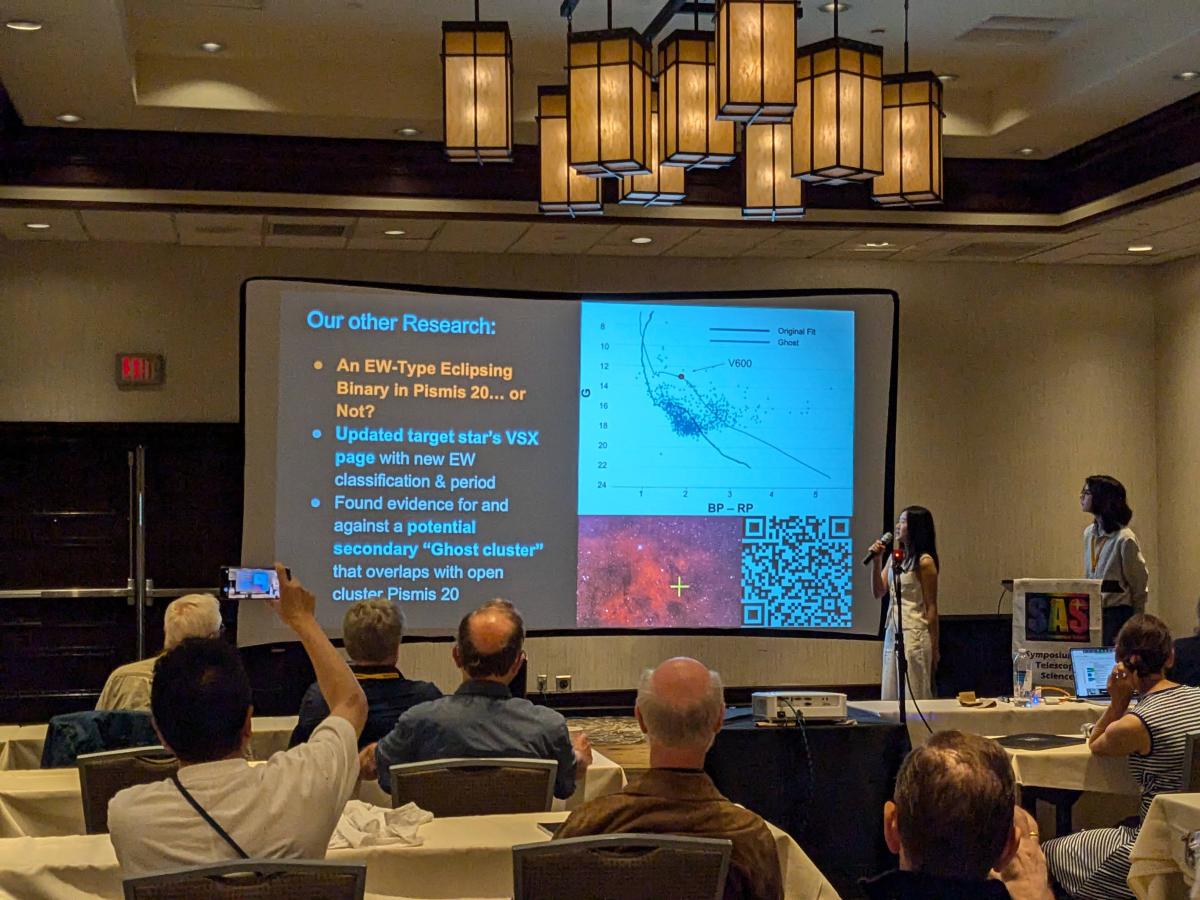
In June, Matt Craig, Mark Munkacsy, Richard Berry, Arne Henden, and I attended the Society for Astronomical Sciences meeting. We presented a total of six talks during the meeting. We thank the SAS leadership for providing us with such a wonderful opportunity.
It was a pleasure to meet many of you for the first time and to reconnect with long-time colleagues and friends.
Strategic Plan Execution
We have made substantial progress on the technical goals of our strategic plan. This includes the release of WebObs 2.0 (whose bugs have been worked out thanks to your feedback) and integration of our website with a new Constituent Relationship Management (CRM) platform with our member database. This later setup preserves historical data while enabling the staff to use modern member management and fundraising tools. This platform is already in use for the Annual Meeting registration and CHOICE courses and will be rolled out to member management later this year.
You will also see a change in the way you can support the AAVSO. Our donation forms are now modernized and easy to use. In the future, you will also see how to support specific funds, easily manage monthly giving, and learn more about ways to support the AAVSO for generations to come.
Website Update
We remain on track to launch our new website in late Q3 of this year. As I have previously mentioned, the current website contains more than 60,000 pages, the vast majority of which will not be migrated. We plan to carry forward approximately 50 pages deemed essential while preserving the rest on an archival site. Redirects will be in place to monitor traffic and identify additional pages that may need to be brought forward over time.
At the same time, we have begun discussions about the future of the Variable Star Index (VSX). Plans include expanding coverage to additional variability types (such as spectroscopic and polarimetric variables) and introducing a modern REST-based web API. If you have suggestions for features or enhancements, please email me.
Finally, as part of the website refresh, we are seeking images of astronomers in action. Richard’s 2025 Presentation at SAS entitled “How to Photograph Astronomers” does an excellent job summarizing the types of images we’re seeking. If you have photographs you are willing to share, please contact me so we can discuss how to best feature them.
Science Highlights
Our colleagues with observatories in the southern hemisphere have been exceptionally busy tracking the evolution of three separate novae. Nova Lup 2025 was discovered by the ASAS-SN survey in early June, peaked at V~5.2, and is now around V~9.0. About a month later, Nova Ser 2025 was discovered by the NMW survey at CV~12 and it has steadily faded down to V~15. These were both fairly typical novae which were observed both photometrically and spectroscopically by AAVSO observers.
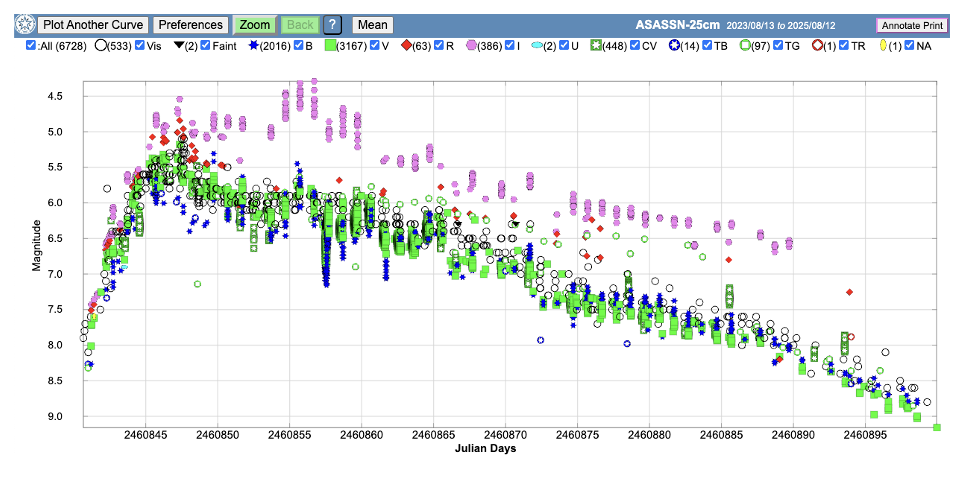
Then there is the peculiar case of Nova Vel 2025. First discovered by John Search in late June at V~5.7, the system took an unusually long time to show emission lines typically seen in novae. It has since been classified as a NA+UGSU (a fast nova that was a SU UMa-type dwarf nova before explosion) and has faded down to V~9.5.
A New Small Research Team and Special Interest Group
As part of AAVSO’s Strategic Plan, we will be launching several Small Research Teams this year. These teams are designed to complete a focused research project and publish their findings within 1-2 years. The work of these groups will encompass the entire scientific process, from data collection, analysis, modeling, and paper preparation. Participation in these groups is limited to AAVSO members only. Teams will meet a few times a month with an AAVSO staff member actively involved in guiding and supporting the work.
Our first team will investigate a newly recognized class of variable stars known as “Eclipsing - Disk Occulting”. About a decade ago, there were only two known objects that exhibited this behavior, Eps Aur and EE Cep; however the class has since grown to approximately 30 objects. Damien Lemay and I will be leading this group.
Building on conversations with Gary Cole, Nicolaus Steenken, and John J. Simpson, the AAVSO is exploring the feasibility of supporting polarimetry within our observing programs. To this end, we have established a Special Interest Group led by AAVSO Board Member Dr. Dipankar Maitra and supported by Dr. Gary Henson and Dr. Richard Ignace from East Tennessee State University. The group’s initial work will focus on determining whether AAVSO should collect and disseminate polarization data and, if so, how best to integrate it into our scientific and data management frameworks.
If any of these activities seems interesting to you, please send me an email.
Volunteer Highlights
Outside of scientific initiatives, the AAVSO offers volunteer programs that help amplify the organization’s scientific impact. One initiative I would like to highlight is revisions to the new member welcome packet being implemented by Kunegunda Belle and Bruce McMath on the Marketing Committee. The revised format will shift from a single large information packet to a series of targeted emails with calls to action delivered over a 10-day period to better engage and orient new members.
Later this month, we will be holding a kickoff meeting for a new Education and Public Outreach Special Interest Group. In addition we are always seeking volunteers to serve as editors and reviewers for the Journal, provide leadership for Special Interest Groups, teach CHOICE courses, mentor new observers, and help with infrastructure and technology projects.
From the Board
During the last quarter, the Board reviewed and approved a new Commercial Engagement Policy which will enable the AAVSO to work more directly with commercial partners in support of our mission.
Looking ahead to our November election, AAVSO President Richard Berry established the 2025 Nominating Committee. This committee is responsible for recommending candidates for the Elected Director positions on the Board of Directors. Bill Dillon has graciously agreed to serve as Chair, with Gordon Myers and Bob Buchheim as committee members.
Clear skies,
Dr. Brian Kloppenborg
Executive Director
American Association of Variable Star Observers
Email: bkloppenborg@aavso.org